
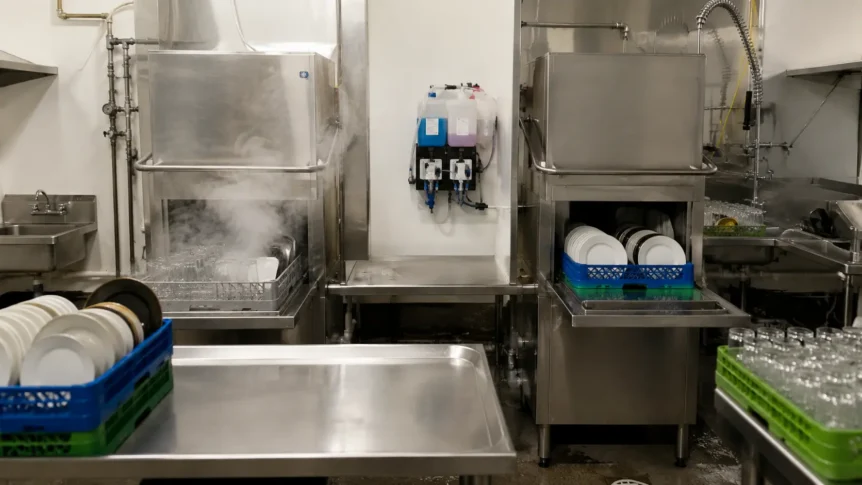
A high-temp dish machine sanitizes with heat, running a booster-heated final rinse at roughly 180°F. A low-temp dish machine sanitizes with a chemical solution, typically chlorine, quaternary ammonium, or iodine, at a wash temperature far too low to sanitize on its own. Both methods are legitimate, code-compliant, and applicable to every style of commercial dishwasher, from conveyor lines to undercounter units.
The difference between high-temp and low-temp determines more than how the dishes get clean. It sets the energy draw, the ongoing chemical order, whether the machine needs a hood, and what a service call usually entails.
The core difference: Heat or chemistry
A high-temp dish machine kills bacteria with heat alone. No chemicals are involved in the final rinse. A low-temp machine does the same job with a chemical sanitizer, usually chlorine, quaternary ammonium (quat), or iodine, circulating at a wash temperature nowhere near hot enough to sanitize on its own.
High-temp machines typically wash at 150°F to 165°F and finish with a final rinse around 180°F at the manifold. That heat is the sanitizer. Low-temp machines wash around a 120°F minimum and depend entirely on the chemical concentration, hitting the right parts-per-million, commonly cited in the range of 50 to 100 ppm for chlorine or roughly 200 ppm for quat. Get the ppm wrong, and a machine can run at the correct temperature and still fail to sanitize.
The mechanism is the whole story here. Everything else, cost, drying, and ventilation, is downstream of this one decision.
What a high-temp machine needs to run right
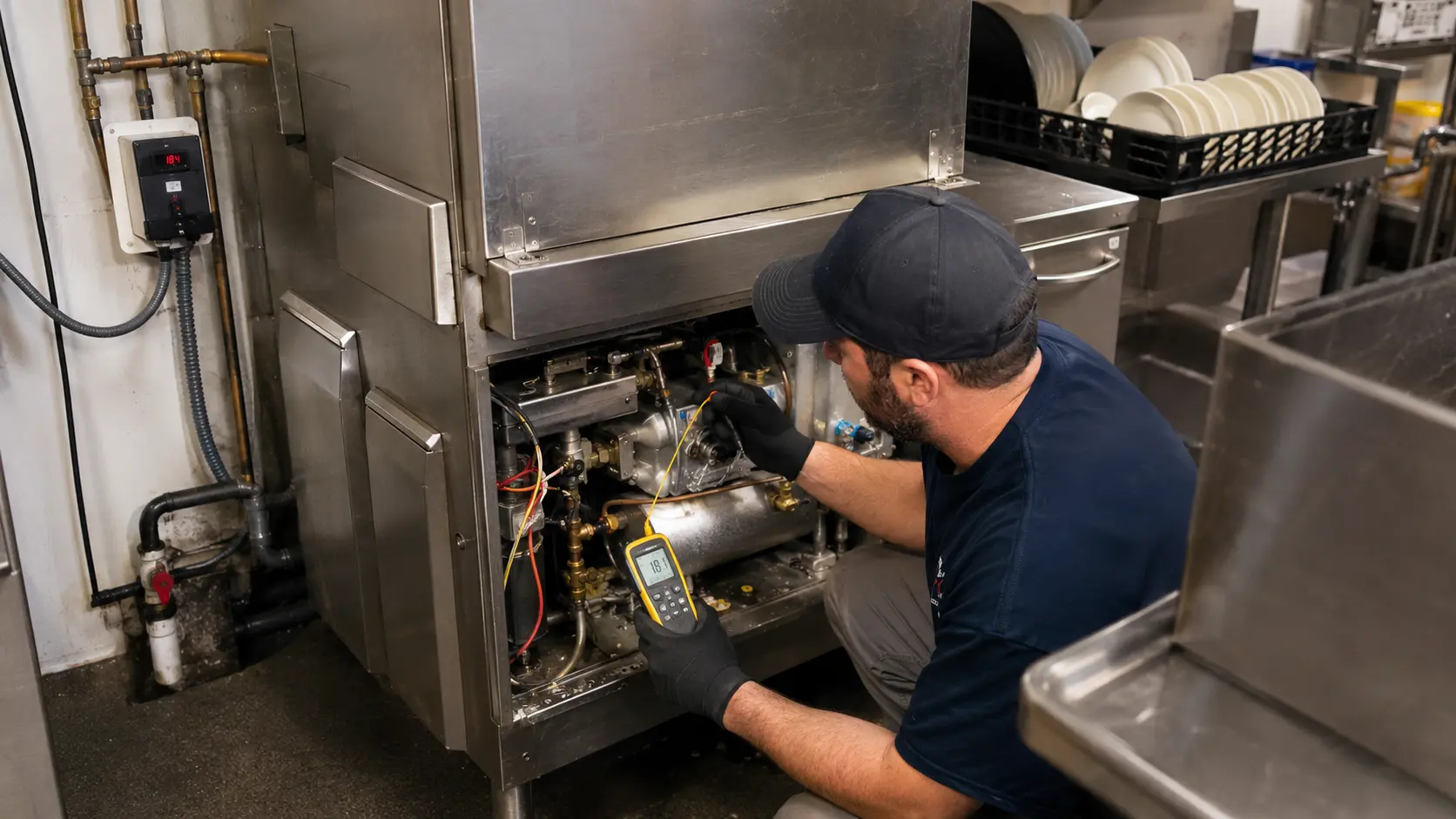
A high-temp machine needs a booster heater, full stop. Most commercial water heaters top out around 120°F to 140°F, nowhere close to the 180°F a high-temp rinse requires, so a dedicated booster heater sits inline to push the final rinse water up to sanitizing temperature.
That booster heater is also one of the most frequent reasons, in our experience, that a high-temp machine stops sanitizing correctly. When it fails, the machine doesn’t stop working. It just quietly stops sanitizing, which is worse. High-temp units also tend to draw more power, and many run on 208 to 240-volt service, often three-phase, so a new installation usually means an electrician is involved before the machine is ever plumbed in.
If you’re planning a new dish pit as part of a larger buildout, that electrical and plumbing prep is exactly what a commercial kitchen equipment installation accounts for before the machine shows up. On the upside, that heat does double duty: it flash-dries dishes as they come off the line, which is why a well-running high-temp kitchen rarely deals with wet stacks.
What a low-temp machine needs to run right
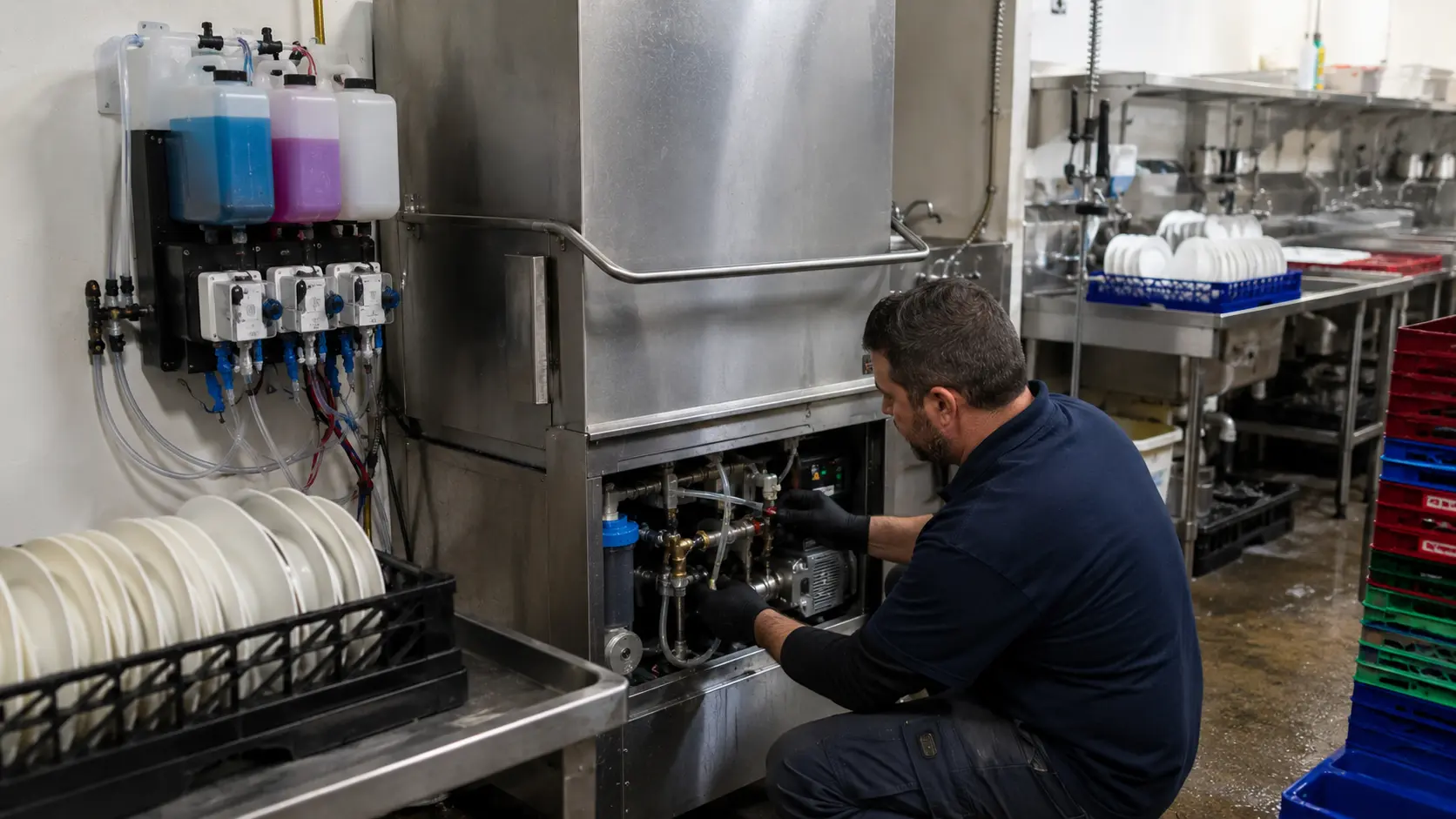
A low-temp machine trades the booster heater for a chemical dispenser, and that dispenser becomes the part that needs the most attention. It has to hold sanitizer concentration inside a narrow band on every cycle, not just most of them.
The trade-off shows up most in the dish room itself. Without flash-drying heat, plates and cups often come off the rack visibly wet and air-dry the rest of the way, which is one of the most common complaints we hear from kitchens that switched from high-temp to low-temp. It’s not a malfunction. It’s just how chemical sanitizing works. A rinse aid speeds that along, but it won’t fully replicate what a 180°F blast does in seconds.
When a low-temp machine does need a service call, more often than not, it’s not the machine itself. It’s the dispenser losing its prime, a chemical container running dry before anyone noticed, or a feed line that’s cracked and pulling air instead of sanitizer.
What each type costs to run
High-temp machines generally cost more to run in energy and less to run in chemicals. Low-temp machines flip that: cheaper energy draw, but a recurring chemical order that never really stops.
The energy gap is mostly due to the booster heater. The U.S. Department of Energy’s federal energy management program notes that upgrading to the most efficient certified commercial dishwasher models can save well over $20,000 in combined utility costs over the machine’s lifetime compared to standard models, and that gap is driven largely by how hard a high-temp booster heater has to work. Low-temp machines skip that draw, but the sanitizer itself becomes a recurring line item, refilled on a schedule rather than paid for once.
Installation cost tends to follow the same pattern. A high-temp system usually requires a booster heater and electrical service to run, which increases the upfront cost of a new install. A low-temp system’s simpler hookup keeps that cost lower, even though the chemical cost catches up over time.
Whichever type is already installed, keeping it under warranty is usually cheaper than either sanitization method’s ongoing cost. We’re factory-authorized warranty service for more than 70 manufacturers, so most repairs on either system are covered under warranty, not an out-of-pocket surprise.
Does machine style matter?
It doesn’t. The sanitizing method and the machine’s physical style are two separate decisions, and either one can be built either way.
A conveyor or flight-type machine handling a high-volume line can run at high or low temperatures. So can a compact undercounter unit in a small kitchen, or a stationary door-type rack machine in between. The style decision is about volume and floor space. The sanitizing decision is about heat versus chemistry. Kitchens sometimes assume undercounter automatically means low-temp because it looks like the smaller, simpler option, but plenty of undercounter machines run high-temp with a compact booster heater built in.
What New York requires for dish machine sanitizing
New York’s Sanitary Code doesn’t pick a side. It accepts either a high-temp or a low-temp machine, as long as the machine actually hits the numbers for its type.
The state code, 10 NYCRR Part 14, sets the framework, and county health departments often spell out the two paths side by side in their own guidance. Columbia County’s requirements, for example, state that a food service kitchen needs a commercial dishwasher with hot water booster capable of reaching 180°F for hot water sanitizing or a low temperature unit with chemical sanitizing. That’s the whole decision in one sentence, and it’s the same choice this article has been walking through.
Exact wording can vary slightly by county, so it’s worth confirming current requirements with your local health department before an inspection, not during one.
Frequently asked questions
What’s the real difference between a high-temp and low-temp dish machine?
A high-temp machine sanitizes with 180°F rinse water and needs a booster heater to get there. A low-temp machine sanitizes with a chemical solution, usually chlorine, quat, or iodine, at a much lower wash temperature. Both are code-compliant in New York. The choice affects energy cost, chemical cost, drying, and ventilation, not food safety.
Why are my dishes coming out of the dish machine still wet?
That’s typical for low-temp machines. Without the flash-drying heat a high-temp rinse provides, dishes air-dry instead, which usually means visible moisture right off the rack. A rinse aid can speed up drying, but it won’t fully replace what heat does. It’s a normal trade-off of chemical sanitizing, not a sign of a broken machine.
My dish machine used to run hot and now it feels cold. Is that normal?
No. A high-temp machine that’s lost its heat has usually lost its booster heater, heating element, or thermostat, not its sanitizing method. That’s a repair issue, not a design change, and it means the machine may not be sanitizing correctly until it’s fixed.
Does a high-temp dish machine need a hood?
Most high-temp door-type machines do, because of the steam released when the door opens after the final rinse. Ventless high-temp models are built specifically to avoid that requirement. Low-temp machines usually don’t need a hood. Exact requirements depend on local code, so confirm with a hood specialist before installation.
Whichever type is bolted into your dish pit right now, it only matters if it’s actually working. A high-temp machine that’s quietly lost its rinse temperature and a low-temp machine that’s quietly lost its chemical concentration fail the same health inspection for different reasons. Neither one announces itself.